
We use cookies and measurement tools from Google to measure our ads and improve this site. By continuing to browse, you agree. You can change this anytime. Privacy Policy
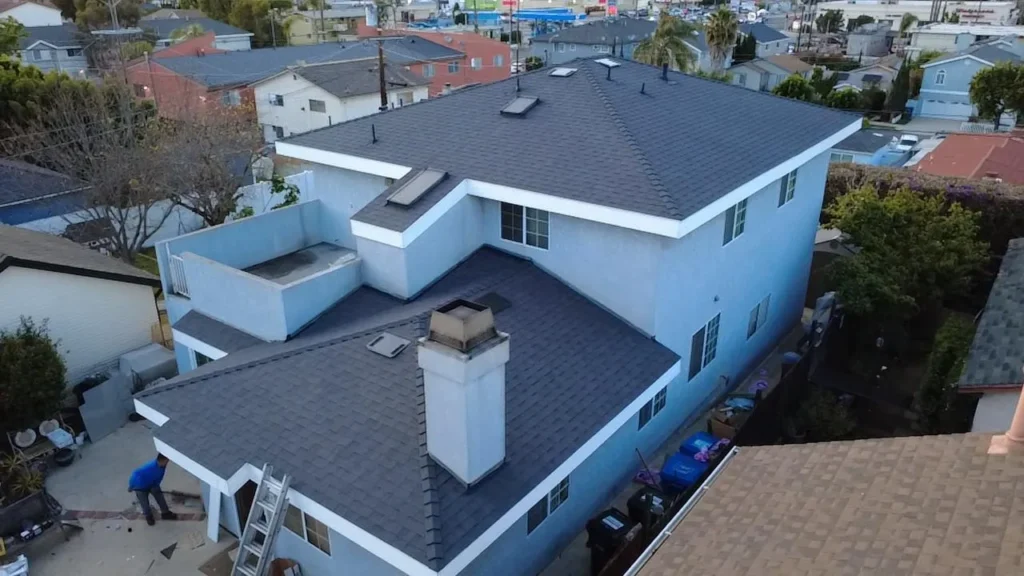
The cost of a roof replacement in Los Angeles depends on the roof’s size and pitch, the material (asphalt shingle, tile or flat torch-down), how many old layers come off, deck repairs found during tear-off, and the permit and Title 24 cool-roof rules. A free on-site estimate turns those into a written price.
This guide gives no dollar figures on purpose. Prices quoted online are national or statewide averages, and the items below are what move a Los Angeles job above or below them. Once you know them, you can read any roofing estimate line by line.
Want a written price for your own roof? Ask AA California Roofing for a free estimate through our contact page.
Every roof replacement estimate in Los Angeles is built from the same six parts. The table shows what each one changes and what a clear estimate should say about it.
| Cost driver | Why it changes the price | What the estimate should state |
|---|---|---|
| 1. Roof area | More squares means more material, labor and disposal. | The number of squares (1 square = 100 square feet of roof surface). |
| 2. Pitch and access | Steep or two-story roofs take longer to work safely; low pitches need extra underlayment. | The pitch, the number of stories, any steep-roof or access charge. |
| 3. Material | Shingle, tile and flat systems differ in covering, underlayment, flashing and labor. | Manufacturer, product line and color, plus the underlayment. |
| 4. Layers to tear off | Each old layer adds labor and dump fees. | How many layers come off, and that the roof is stripped to the deck. |
| 5. Deck and hidden repairs | Rotten sheathing only shows after tear-off. | A unit price for deck replacement, written in before work starts. |
| 6. Code items and permit | Cool-roof products, fire-rated roofing in hazard zones, insulation on some flat roofs, and the permit fee. | A separate line for the permit and for each code item. |
A house listed at 2,000 square feet does not have a 2,000-square-foot roof. Overhangs add surface, a steeper pitch adds more, and a two-story house of the same floor area has a smaller roof than a single-story one. That is why two homes of the same listed size can get very different quotes.
Roofers measure the roof itself and count squares. The City of Los Angeles asks for the same number: the express re-roof permit issued by the Department of Building and Safety (LADBS) records the job size in squares.
Pitch is written as rise over run, so 4:12 means the roof rises 4 inches for every 12 inches across. The California Residential Code allows asphalt shingles only on roofs of 2:12 or steeper and requires a double layer of underlayment from 2:12 up to 4:12. Clay and concrete tile need at least 2.5:12, with double underlayment up to 4:12. Below those pitches the roof is a low-slope (flat) roof and takes a membrane system instead, which is priced differently.
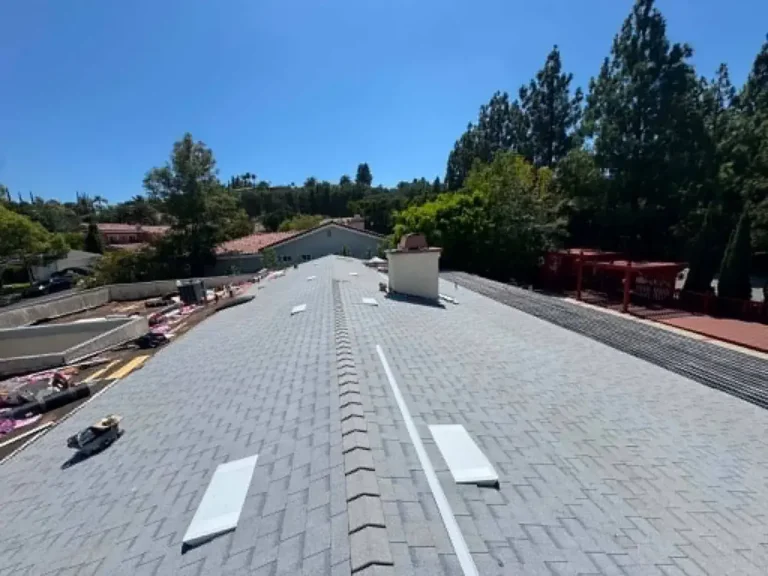
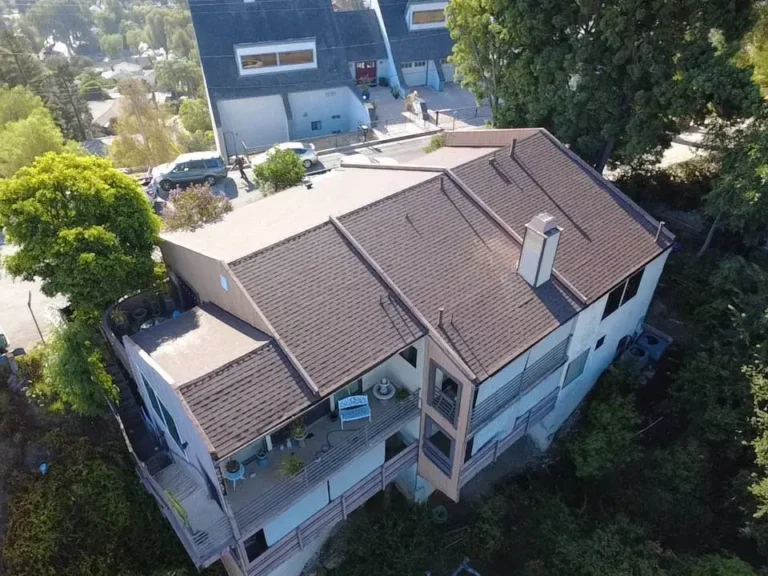
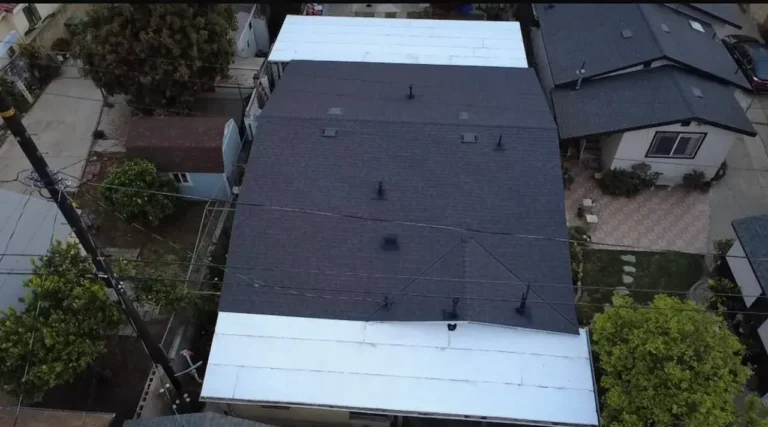
Material is the choice you control most, and in Los Angeles it is tied to the code. The comparison below covers what each system requires, not a price per square, because those depend on the product you pick.
| System | Where it can go | Los Angeles code notes | What moves its price |
|---|---|---|---|
| Asphalt shingle | Pitch 2:12 or steeper, over solid sheathing | Cool-rated product needed on most re-roofs of more than half the roof | Color (cool-rated darker shingles), underlayment on low pitches, deck repairs |
| Clay or concrete tile | Pitch 2.5:12 or steeper | Sound tile can be reused on new underlayment | Whether tiles are reused or new, roof structure, broken-tile replacement |
| Flat (torch-down and other membranes) | Pitch under 2:12 | High reflectance required; insulation required in many inland zones | Added insulation, flashing heights at walls and equipment, drainage |
Shingles must be fastened to wood structural panels or solid lumber. Older homes that once had wood shakes often sit on spaced boards, so the deck has to be sheathed before shingles go on, a cost that shows up only on those houses.
Color matters more in Los Angeles than in many places. The city’s cool roof fact sheet, published by LADBS and the Department of Water and Power (LADWP), notes that costs can increase for asphalt shingle products in a color other than white, because darker shingles have to be cool-rated products to meet the rule. Ask for the cool-rated version of the color you like and compare it with a lighter one.
Tile is the material where reuse can change the math. The California Residential Code allows existing clay or concrete tile to be reinstalled, except tiles that are damaged, cracked or broken. LADBS lists “remove existing roof tiles, apply new underlayment and reset roof tiles” as its own express permit, and that job does not have to meet the cool-roof rule.
Switching to tile from a lighter material works the other way. The code requires the roof structure to carry the new roof system, and the LADBS express re-roof permit covers roofing that weighs less than 6 pounds per square foot. If your new roof is heavier, ask whether it needs a plan check and an engineer’s review before you compare prices. We can price both options, reuse and new tile, on the same visit.
On a flat roof, the energy code can add work beyond the roofing itself. Under California’s 2025 Energy Code, replacing more than half of a low-slope roof on a house requires roofing with high solar reflectance in climate zones 4 and 6 through 15. In zones 1, 2, 4 and 8 through 16 it also requires continuous insulation of R-14 at the roof, unless the roof already has enough insulation or an exception applies.
The Energy Commission’s ZIP code list puts much of the San Fernando Valley and central Los Angeles (91364 Woodland Hills, 90028 Hollywood) in zone 9 and much of South Los Angeles (90001) in zone 8, so the insulation rule applies there. Coastal ZIP codes such as 90405 Santa Monica and 90503 Torrance are in zone 6, where the code adds no insulation requirement.
Added insulation raises the roof surface, which is why the code has exceptions where it would push flashing at walls, parapets and rooftop equipment below the manufacturer’s minimum height. Our flat roof services page covers torch-down and the other systems we work with.
Most surprises on a roof replacement come from what sits under the old roofing. These are the items to ask about before you sign, so each one has a known price if it turns up.
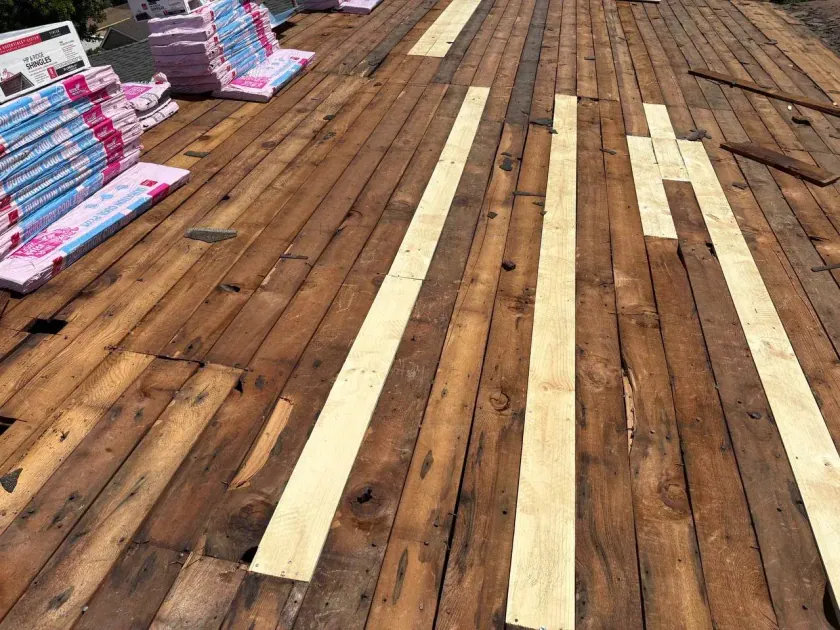
A roof replacement removes the old roofing down to the deck. The state Energy Code's own definition of a roof replacement includes "repairing any damaged substrate", and water-soaked or rotten sheathing is often invisible until the old layers are gone. Ask for a unit price for replacing damaged sheathing in the contract, so a bad section costs a known amount instead of an open-ended change order.
Putting new roofing over old (a recover) is not allowed when the roof already has two or more layers, when the existing roof is water-soaked or deteriorated, or when it is slate, clay or cement tile. Each layer that comes off adds labor and disposal. A recover also does not avoid the cool-roof rule: the Energy Code counts adding a new surface layer on top of the existing one as a re-roof.
The code requires flashings, edgings, vents and similar parts that are rusted, damaged or deteriorated to be replaced, not reused, and flashings to be rebuilt to the roofing manufacturer's instructions. A low estimate that reuses old metal can turn into a higher final bill.
Enclosed attics need cross ventilation, with a net free vent area of at least 1/150 of the attic's area (half that with balanced high and low venting under the code's conditions). If the existing vents fall short, adding them is part of the job. In wildland-urban interface areas, vents must also resist burning embers under the state's wildland-urban interface code, so the vent type on the estimate matters.
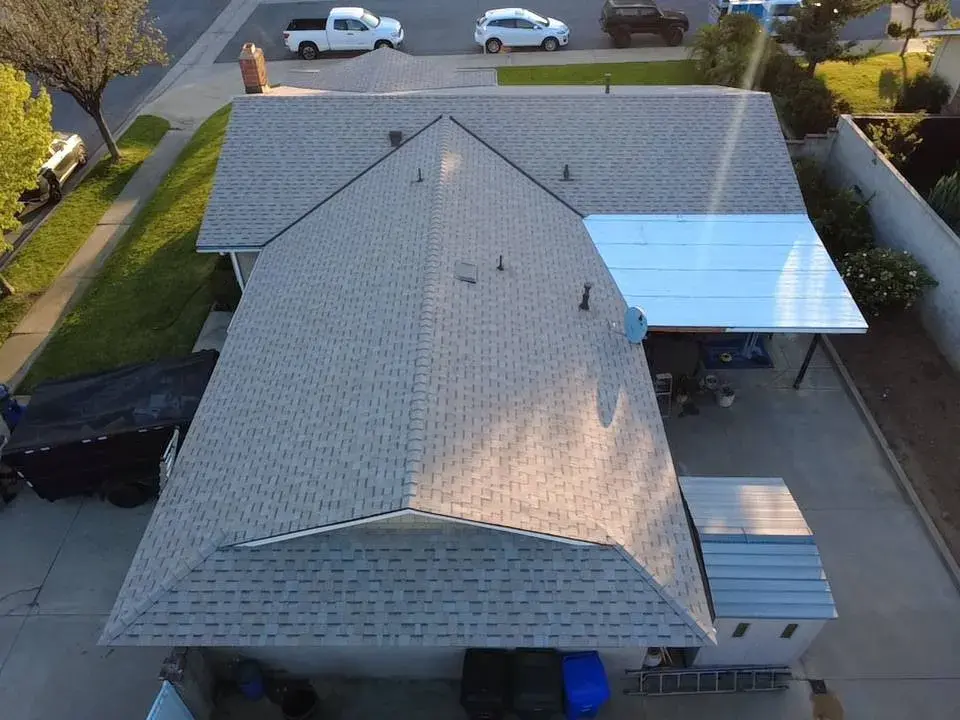
Inside the City of Los Angeles, a straightforward re-roof is an express permit from LADBS: no plan check, issued online or by appointment at the Metro, Van Nuys, West Los Angeles, South Los Angeles and San Pedro counters. The fee is set by LADBS from its current schedule, not by the roofer, and LADBS publishes a Permit Fee Calculator for estimating it. We do not print a fee here because it depends on your job and on the schedule in force when the permit is issued.
Two fee details are worth knowing. LADBS charges for an extra inspection trip when one is needed, so a failed inspection adds cost. And if your home is in a very high fire hazard severity zone, the express permit requires Class A roofing, which narrows the products you can price.
Homes in Pasadena, Santa Monica, Torrance and other cities pay their own city’s fees. Our guide on when you need a roofing permit in Los Angeles explains which office handles which address.
The state contractors board (CSLB) recommends getting at least three written bids on the same plans, specifications and scope, and warns that a bid far below the others usually means a mistake or missing work. Use this checklist to put estimates side by side.
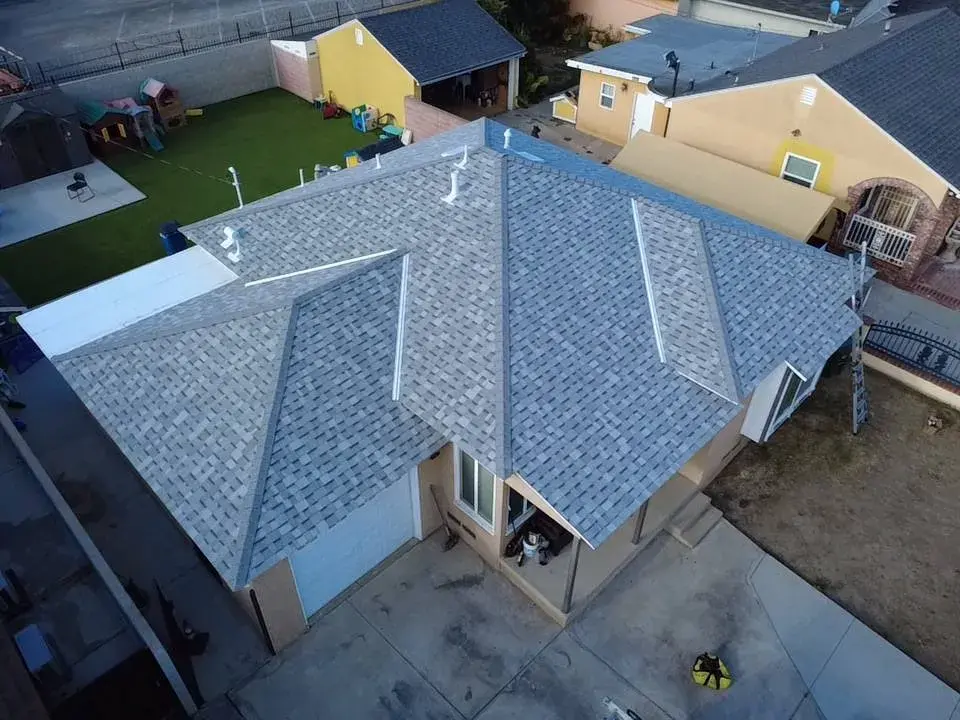
A roof replacement is a large, often unplanned expense. Ask us about same-day approvals and easy application options. Financing options, when offered, are subject to third-party lender approval; the roof financing page explains how to apply.
If you are an LADWP customer, a qualifying cool roof can also earn a rebate per square foot through LADWP’s Consumer Rebate Program. It requires a CRRC-rated product and the final approved building permit, so plan for it before the job starts. Our cool roof requirements guide covers the ratings and the rebate terms.
Not on the home you live in. The IRS counts a new roof as an improvement, so you do not deduct it; its cost is added to your home’s basis, which can lower the taxable gain when you sell (IRS Publication 523). On a residential rental property, roof repairs are generally a deductible rental expense and a new roof is depreciated over 27.5 years (IRS Publication 527). A roof installed in 2026 earns no federal credit either: the Energy Efficient Home Improvement Credit covered improvements made through December 31, 2025, and its list of qualifying items names no roofing.
| Roof work | The home you live in | A residential rental property |
|---|---|---|
| New roof | Not deductible. Its cost, materials and the labor you pay for (not your own), goes into your home’s basis. That lowers your tax only if your gain on a sale is more than the amount you can exclude for a main home. | Depreciated over 27.5 years, the recovery period for residential rental property under the general depreciation system, counted from when the new roof is placed in service. |
| Roof repair | Not deductible, and generally not added to basis; fixing leaks is one of the IRS’s own examples of a repair. Repairs done as part of an extensive remodeling or restoration count as improvements. | Generally deductible as a rental expense in the year you pay it, unless it has to be capitalized as an improvement. |
| Federal energy credit | None for a new roof: the credit is not allowed for property placed in service after December 31, 2025, and its list (exterior doors, windows and skylights, insulation, home energy equipment, home energy audits) names no roofing. | Not available to a landlord who does not live in the home. |
Sources: IRS Publications 523, 527 and 530 (editions for 2025 returns) and the IRS page on the Energy Efficient Home Improvement Credit.
Keep the signed contract, the final invoice and proof of payment with your home records: Publication 530 tells homeowners to keep receipts or other proof of improvements. On a rental, ask for repair work and the replacement on separate lines, since Publication 527 tells owners to separate the costs of repairs and improvements. The estimate checklist above covers what else the contract should state.
The rebate and financing above have tax rules of their own. Publication 530 says a public utility’s subsidy for an energy conservation measure is not counted as income and reduces your home’s basis, so ask whether that applies to an LADWP cool roof rebate. If you use roof financing, the interest can count as deductible home mortgage interest only when you itemize your deductions instead of taking the standard deduction, and only when the loan is secured by your home and used to buy, build or substantially improve it; ask the lender whether the loan is secured by the home.
This is general information from IRS publications, not tax advice; ask a tax professional how it applies to your return.
The only accurate number for your house comes from measuring it. AA California Roofing is a licensed California roofing contractor (C-39), CSLB License #1147688, replacing roofs across Los Angeles County and nearby Ventura County cities; our published Google reviews include a roof replacement in Pasadena and a new roof in Torrance. Transparent pricing, no hidden fees.
Schedule your free estimate online, or read more about our roof replacement service. If only part of the roof is failing, a repair may be enough; see roof repairs. More answers are in our roofing guides.