
We use cookies and measurement tools from Google to measure our ads and improve this site. By continuing to browse, you agree. You can change this anytime. Privacy Policy
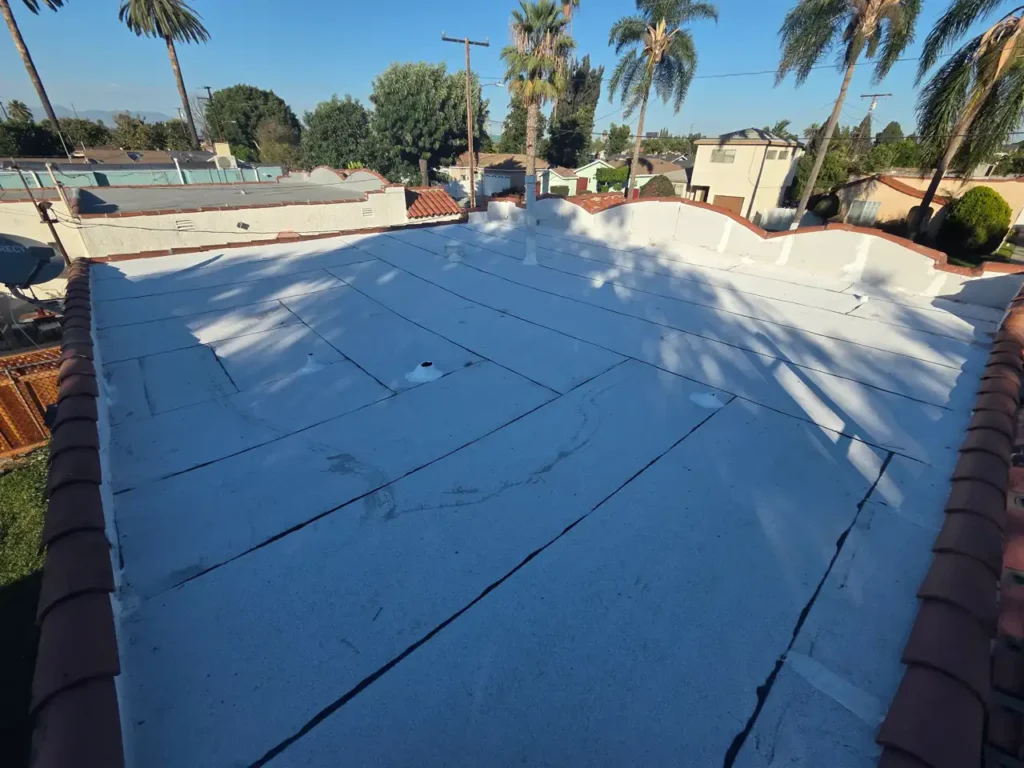
When you replace a roof in Los Angeles, California’s cool roof rules in the Energy Code (Title 24) and the City of Los Angeles cool-roof ordinance can require roofing that reflects sunlight, rated by the Cool Roof Rating Council (CRRC). Which rule applies depends on the roof’s slope, the building type and the climate zone; your roofer documents compliance on the permit.
Both rules start at the same line: replacing more than half of the roof. Below that, a re-roof or repair keeps whatever roofing you like. Above it, the product you choose has to meet a minimum reflectance, and on a flat roof the state rule can add insulation too.
Replacing a roof and want to know which rule covers your house? Book a free estimate online with AA California Roofing; it includes the cool-roof check.
| Your roof | California Title 24 (2025 code) | City of Los Angeles Green Building Code |
|---|---|---|
| Steep roof, climate zones 8, 9 or 14 | Aged solar reflectance 0.20 and thermal emittance 0.75, or SRI 16, unless an exception applies | Aged solar reflectance 0.25 and thermal emittance 0.85, or SRI 20 |
| Steep roof, climate zone 6 or 16 | No reflectance requirement | Same city values as above |
| Low-slope (flat) roof, zones 6, 8, 9 or 14 | Aged solar reflectance 0.63 and thermal emittance 0.75, or SRI 75 (or the insulation trade-off) | Aged solar reflectance 0.65 and thermal emittance 0.85, or SRI 78 |
| Low-slope roof, zone 16 | No reflectance requirement | Same city values as above |
| Half the roof or less replaced | Not triggered | Not triggered |
The city column is the city’s rule for residential buildings and applies only inside the City of Los Angeles; non-residential roofs in the city have separate, higher city values (see the cool roof questions below). The state column applies everywhere in California, including Pasadena, Santa Monica, Torrance and the Ventura County cities. Where both apply, the product has to satisfy both, and the city’s values are the higher ones.
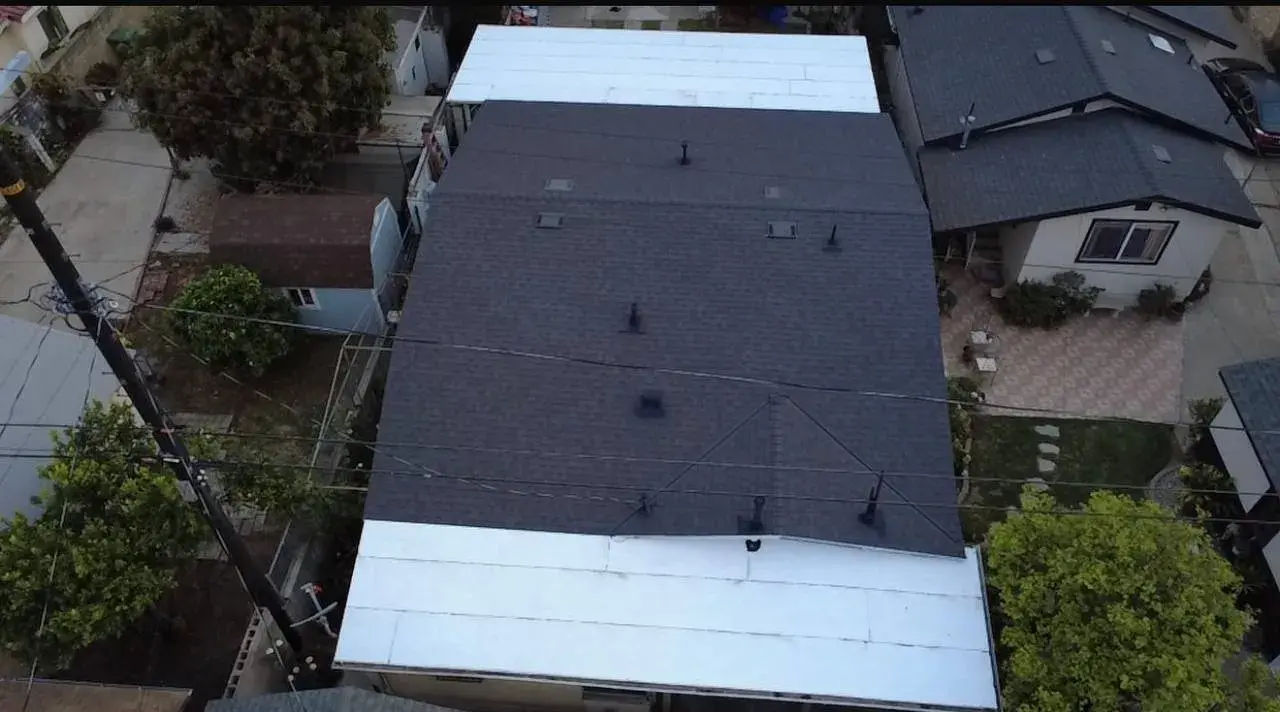
A cool roof reflects most of the sunlight that hits it and gives off the heat it does absorb, so less heat moves into the attic and rooms below. The CRRC measures two properties for each product, on a scale from 0 to 1:
Codes use the aged values: the CRRC weathers products outdoors for three years and rates them again, because some surfaces lose reflectance as they collect dirt and weather. A cool roof does not have to be white. The CRRC notes that “cool color” products use darker pigments that reflect strongly in the near-infrared part of sunlight, which you cannot see.
Every product used to meet the code must be rated by the CRRC, and its packaging label (or its listing in the CRRC Rated Roof Products Directory) is how you check it. The directory has a “Minimum Radiative Properties” search for finding products that meet a given set of values.
California’s Energy Code (Title 24, Part 6) is updated every three years. Permit applications filed on or after January 1, 2026 fall under the 2025 code. For a house, Section 150.2(b)1I applies the cool-roof values when more than 50 percent of the roof is replaced, and it counts adding a new layer on top of the old one as a replacement too.
A steep roof is one with a pitch of 2:12 or more, which covers shingle and tile roofs. In climate zones 4 and 8 through 15, new roofing needs an aged solar reflectance of at least 0.20 and thermal emittance of at least 0.75, or an SRI of at least 16. The code treats any of these as equivalent, so the requirement drops away if the house has:
Roof areas covered by building-integrated solar panels, and roof constructions weighing at least 25 pounds per square foot, are also exempt.
A low-slope roof has a pitch under 2:12. In climate zones 4 and 6 through 15, new roofing needs an aged solar reflectance of at least 0.63 and thermal emittance of at least 0.75, or an SRI of at least 75. Insulation at the roof deck can stand in for reflectance: in zones 6 and 7, R-10 continuous insulation removes the reflectance requirement, and in zones 2, 4 and 8 through 15 it takes R-24 (Table 150.2-E has the steps in between).
The 2025 code also requires the replaced low-slope roof to be insulated to R-14 continuous in climate zones 1, 2, 4 and 8 through 16, with exceptions for roofs that already have R-10 continuous insulation, roofs with R-19 between the rafters against the deck in zones 1, 2, 4 and 8 through 10, and a reduced requirement where added thickness would cut flashing height at walls, parapets or rooftop equipment.
Non-residential re-roofs follow Section 141.0(b)2B. When more than 50 percent of the roof, or more than 2,000 square feet, whichever is less, is replaced, low-slope roofs need an aged solar reflectance of 0.63 and thermal emittance of 0.75, or SRI 75, in every climate zone. Multifamily buildings have their own rules in Section 180.2.
The Energy Commission publishes a list that assigns each ZIP code to a building climate zone. The Los Angeles area crosses several zones; these examples come straight from that list:
| Zone | Example ZIP codes from the Energy Commission list | Steep re-roof rule | Low-slope re-roof rule |
|---|---|---|---|
| 6 | 90405 Santa Monica, 90503 Torrance, 90802 Long Beach, 90731 San Pedro, 90066 Mar Vista | No | Yes (no R-14) |
| 8 | 90001 and 90044 South Los Angeles, 90230 Culver City, 90301 Inglewood, 90241 Downey | Yes | Yes, plus R-14 |
| 9 | 91364 Woodland Hills, 91601 North Hollywood, 90028 Hollywood, 91101 Pasadena, 91201 Glendale, 93063 Simi Valley | Yes | Yes, plus R-14 |
| 14 | 93534 Lancaster, 93550 Palmdale | Yes | Yes, plus R-14 |
| 16 | 91040 Sunland, 91042 Tujunga, 91390 Canyon Country | No | No reflectance rule, but R-14 |
A ZIP code can cross a zone line, so treat the list as a starting point; the Energy Commission’s climate zone tool and your building department have the final word for a specific address.
Inside the City of Los Angeles, the city’s Green Building Code adds its own cool-roof rule for residential buildings, and it applies citywide rather than by climate zone. LADBS’s current express permit bulletin (P/GI 2026-003) puts it plainly: for a residential roof replacement of more than 50% of the total roof area, apply a cool roof product labeled and certified by the CRRC.
The values, as published in the city’s cool roof fact sheet from LADBS and LADWP, are an aged solar reflectance of 0.65 and thermal emittance of 0.85, or SRI 78, for low-slope roofs (2:12 or less), and 0.25 and 0.85, or SRI 20, for steep roofs (more than 2:12). LADWP’s 2026 rebate terms use the same SRI thresholds of 78 and 20 “according to LA Green Building Code”. Note the slope line: the city puts a roof of exactly 2:12 in the low-slope group, while Title 24 puts it in the steep group.
The city’s list of exceptions is shorter than the state’s. Per the fact sheet, a cool roof is not required for:
The state’s attic exceptions (R-38 insulation, a radiant barrier, no ducts in the attic) are not on the city’s list. A house in Woodland Hills that is exempt from the state rule because of its attic insulation can still need a cool roof under the city code. And in coastal zone 6 neighborhoods of the city, where the state sets no steep-roof requirement, the city rule still applies.
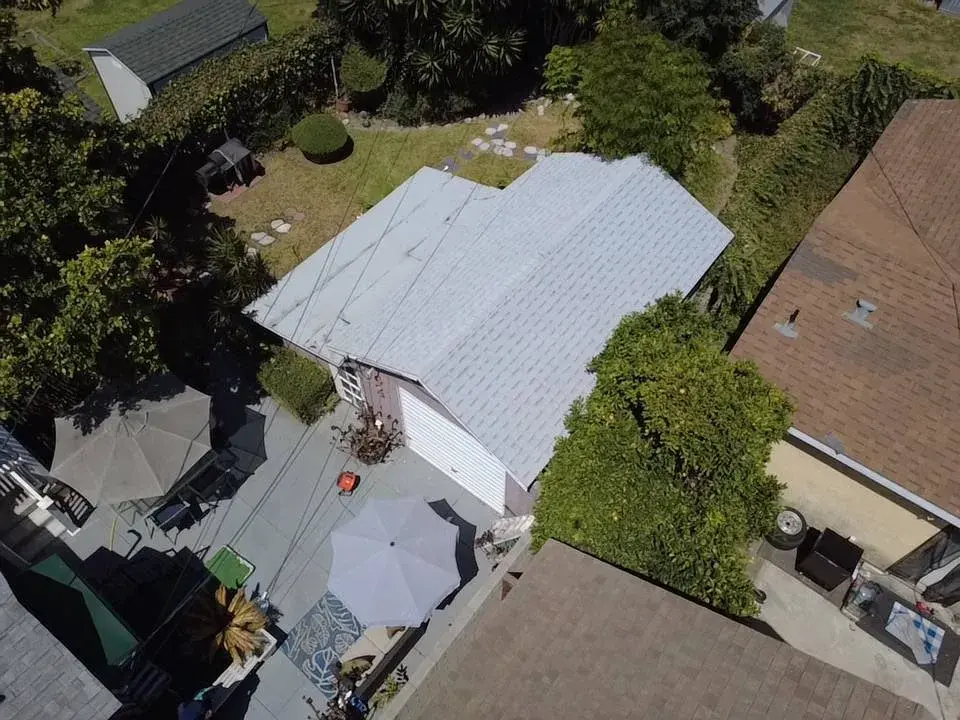
Every common roof type has CRRC-rated products. The city’s fact sheet lists cool roofs in shingle, shake, tile, membrane and spray-on coating styles, in colors from white to black, including blues, grays, greens, browns and tans.
Cool-rated shingles come in many colors, but the city’s fact sheet notes that costs can increase for asphalt shingle products in a color other than white. Check the CRRC product ID of the exact color, because a manufacturer’s cool line and standard line can look alike. Our roof replacement cost guide covers how this shows up in a price.
The fact sheet says most compliant roof types, tiles included, have little or no added cost over non-cool versions, and that cool clay tile comes in a wide range of colors and styles. For historic buildings and zones, the approval process for a cool roof is the same as for any other roof.
If your tiles are sound and only the underlayment has failed, LADBS treats removing and resetting the tiles on new underlayment as its own express permit, and that job does not have to meet the cool-roof rule. See our tile roofing page for the work we do on tile.
Flat roofs face the highest reflectance values in both codes, and on a full replacement in zones 8, 9, 14 and 16 the state’s R-14 insulation rule as well. Membranes and field-applied coatings are rated by the CRRC too. A coating over a sound existing roof is its own LADBS express permit and an option when the membrane underneath is still watertight. Our flat roof services page covers torch-down and coating work.
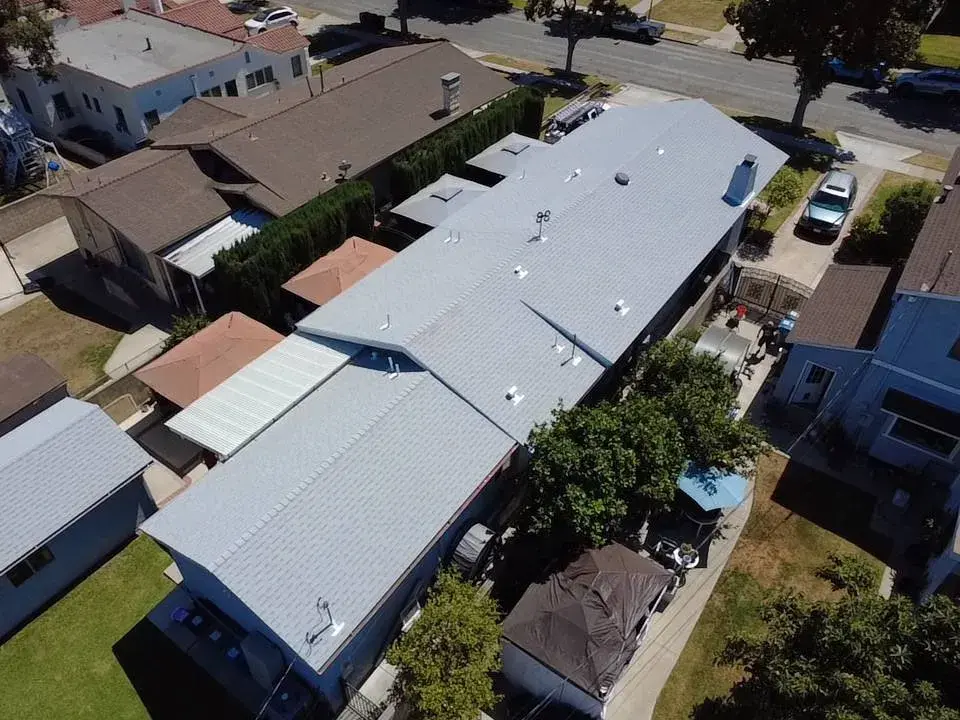
It lowers the heat load, and how much that shows on a bill depends on the house. The CRRC says a cool roof keeps the building cooler, so air conditioning does not have to work as hard, and it may extend the roof’s service life, adding that individual results vary with the climate and the installation. The city’s fact sheet makes the same point and adds the citywide reason for the rule: lower roof temperatures across the city reduce the urban heat island effect.
Title 24 itself shows where the effect is smallest. It accepts R-38 attic insulation, an attic radiant barrier or an attic without ducts as equivalent to a cool roof on steep roofs, which suggests the gain is largest in a hot attic with ducts running through it and smaller in a well-insulated one.
LADWP residential customers can claim a rebate for a qualifying cool roof through the Consumer Rebate Program. Under the terms published for 2026:
LADWP lists the current rebate amounts on its program page, and it can inspect the installation before paying.
AA California Roofing is a licensed California roofing contractor (C-39), CSLB License #1147688, working on homes and businesses across Los Angeles County and nearby Ventura County cities. Use our contact page to plan a roof replacement that meets the rules from the start. More answers are in our roofing guides.
Yes, once more than half of the roof is replaced. Inside the City of Los Angeles, a residential re-roof past that line must use a product labeled and certified by the Cool Roof Rating Council (CRRC), in every climate zone of the city (LADBS express permit bulletin P/GI 2026-003), unless a city exception applies, such as solar being installed. For houses, California’s Title 24 Energy Code uses the same 50 percent line statewide, but only in the climate zones it lists. On a house, a repair or replacing half the roof or less needs no cool-roof product under either rule.
Woodland Hills, Van Nuys, North Hollywood, Hollywood and San Pedro are all inside the city. Pasadena and Santa Monica are separate cities: there the state rule applies, plus any rule that city adds. This page sets out the city’s values and exceptions under The City of Los Angeles cool roof ordinance and the state’s zones under When does Title 24 apply to a re-roof?
Commercial and other non-residential roofs in the city follow a separate city section with higher values: LAMC 99.05.106.13 asks for an aged SRI of 82 at a slope of 2:12 or less and 27 on steeper roofs (or the matching reflectance and emittance values), once more than half the roof is replaced and unless an exception applies, such as a repair or solar being installed. Our free estimate for a roof replacement in Los Angeles includes the cool-roof check.
Not on every roof. For houses, California’s Energy Code (Title 24, Part 6) sets cool-roof values for new homes and for re-roofs of more than half the roof, and then only in the climate zones the code lists. Cities can add their own rule on top, as Los Angeles has.
The prescriptive list for a newly built single-family home (Section 150.1(c)11) is shorter than the re-roof list: steep roofs only in zones 10 through 15, low-slope roofs only in zones 13 and 15. Zone 9 (on the Energy Commission’s ZIP list, 91364 Woodland Hills, 91101 Pasadena and 91201 Glendale) is on the re-roof list for both slopes and not on the new-home list. This page sets out the re-roof zones and exceptions under When does Title 24 apply to a re-roof?
Summaries written for earlier editions of the code may say a house in zones 1 through 9 needs no state cool roof. Under the 2025 code, replacing more than half of a steep roof in zones 4, 8 or 9 does need one, unless one of the code’s exceptions applies.
Commercial buildings have their own state trigger, set out on this page under Commercial and apartment buildings; our commercial roofing page covers that work.